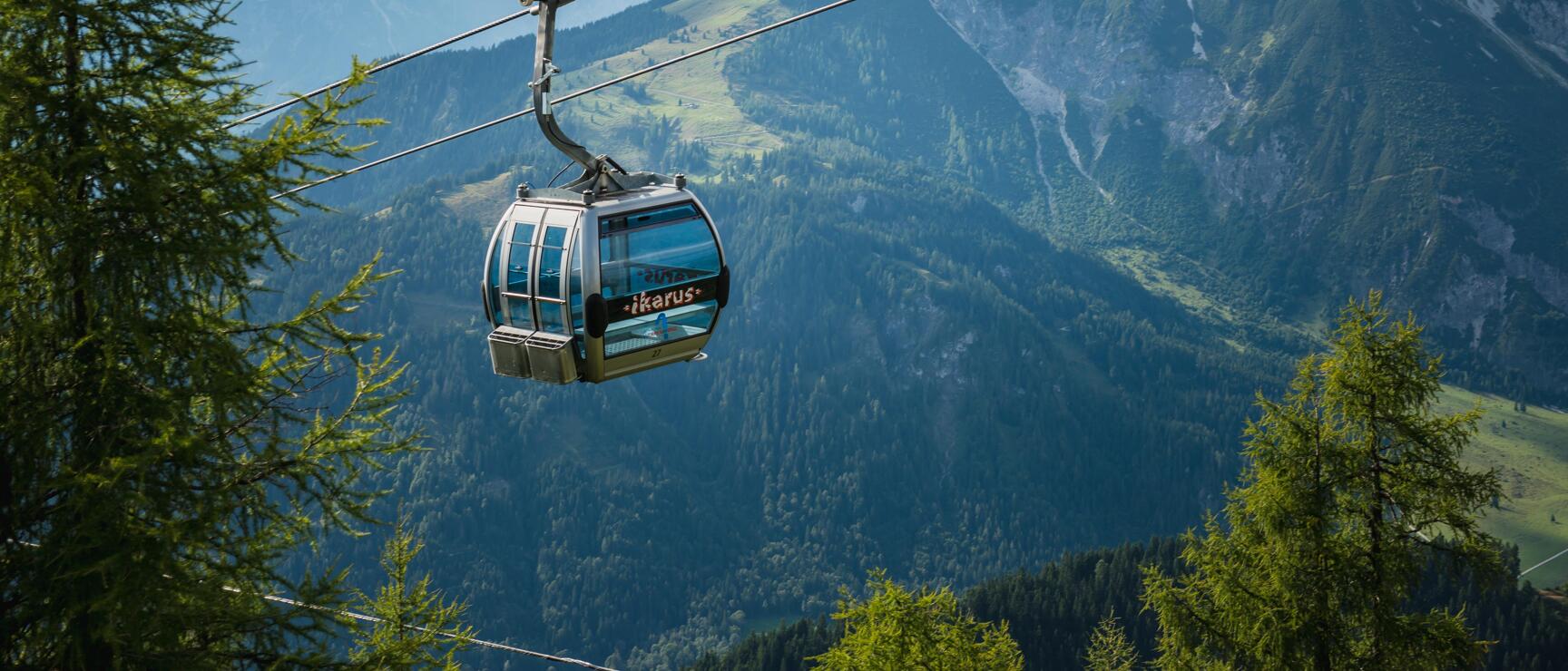
Cable cars in Austria
Mountain experiences and panoramic views by cable car
Introduction
Austria's mountain lifts open up views that would otherwise cost a full day's climb — sweeping alpine panoramas, ridge-top platforms, summits reached in minutes. Gondolas also bring the high mountains within reach of people who could not get there on foot at all.
Most lifts are step-free and allow dogs on board, so the way up is straightforward whoever you are travelling with.
Austria's cable cars are electrically powered, and the country's electricity comes largely from hydropower. Individual operators have gone further: at Golm in the Montafon, 312 m² of solar modules are built into the cladding of the Hüttenkopfbahn's valley and mountain stations — the world's first photovoltaic chairlift, generating around 60,000 kilowatt hours a year, the equivalent of about a third of the lift's annual consumption.
Whether for skiing in winter or for the views in summer, the mountains stay within easy reach all year round.
What approaches are Austrian cable cars implementing?
Austrian cable car operators have been investing in technical improvements for years. Some of the main areas:
Energy efficiency: measured against transport capacity, the sector has reduced its energy use by around 20% over the past decade (source: Fachverband Seilbahnen, WKO - Link in German).
Photovoltaics: solar modules on station roofs and buildings generate electricity on site. At Golm in the Montafon, 312 m² of modules on the Hüttenkopfbahn produce around 60,000 kilowatt hours a year — the equivalent of about a third of that lift's annual consumption.
Digital snow measurement: GPS-based snow depth monitoring lets operators target snowmaking and slope grooming precisely, so snow is made only where it is actually needed.
Getting there by train and bus: ski buses and rail connections serve many resorts, and charging points are available for guests arriving by electric car.
Emissions reporting: an industry-wide CO₂ calculator gives operators a standardised way to record and report their emissions.
Modernising Austria's cable cars — summer & winter
Solar modules on station roofs, drive systems replaced as lifts are renewed, ski buses and rail connections to valley stations: Austrian cable car operators are modernising alpine infrastructure. The examples below set out what has been built — and what it delivers.Nine ski regions with energy and mobility projects
Nine ski regions, nine concrete projects: hydropower and photovoltaics, rail and bus connections, snowmaking managed by GPS. Here is what has actually been built.A short code of conduct for four-legged travellers
Dogs on holiday make excellent hiking companions, and many Austrian cable cars will carry them. Rules differ from operator to operator, though, so check before you set off: most ask for a lead, some also for a muzzle, and most charge a small fare for dogs.
Keep your dog on the lead on the mountain too. Alpine pastures are working farmland, with grazing livestock and ground-nesting birds — and if you do meet cattle, keep your distance, never come between a cow and her calf, and follow local guidance on what to do. And bring poo bags.
In the Wilder Kaiser region in Tirol, with views of the Kitzbühel Alps, dogs are welcome on several summer mountain lifts, including the Hartkaiser lift in Ellmau, the Brandstadl lift in Scheffau and the gondola lifts between Söll, Hochsöll and Hohe Salve.
In the Dachstein Salzkammergut region in Upper Austria, there are several dog-friendly cable cars and gondolas, such as the Dachstein Krippenstein lifts, the Gosaukammbahn Zwieselalm and the Salzberg lift in Hallstatt.
In Vorarlberg’s Montafon region, the Montafon mountain lifts welcome dogs all year round, providing access to peaks such as Muttersberg, Kristberg and Hochjoch.
To the cable car by public transport
Many cable car stations are located close to ÖBB railway stations or offer shuttle services. The mobility programmes of 'Austria's Climate and Energy Model Regions' also make it easy to get there by bus or train.
The following cable cars and regions are particularly well connected to the public transport network: