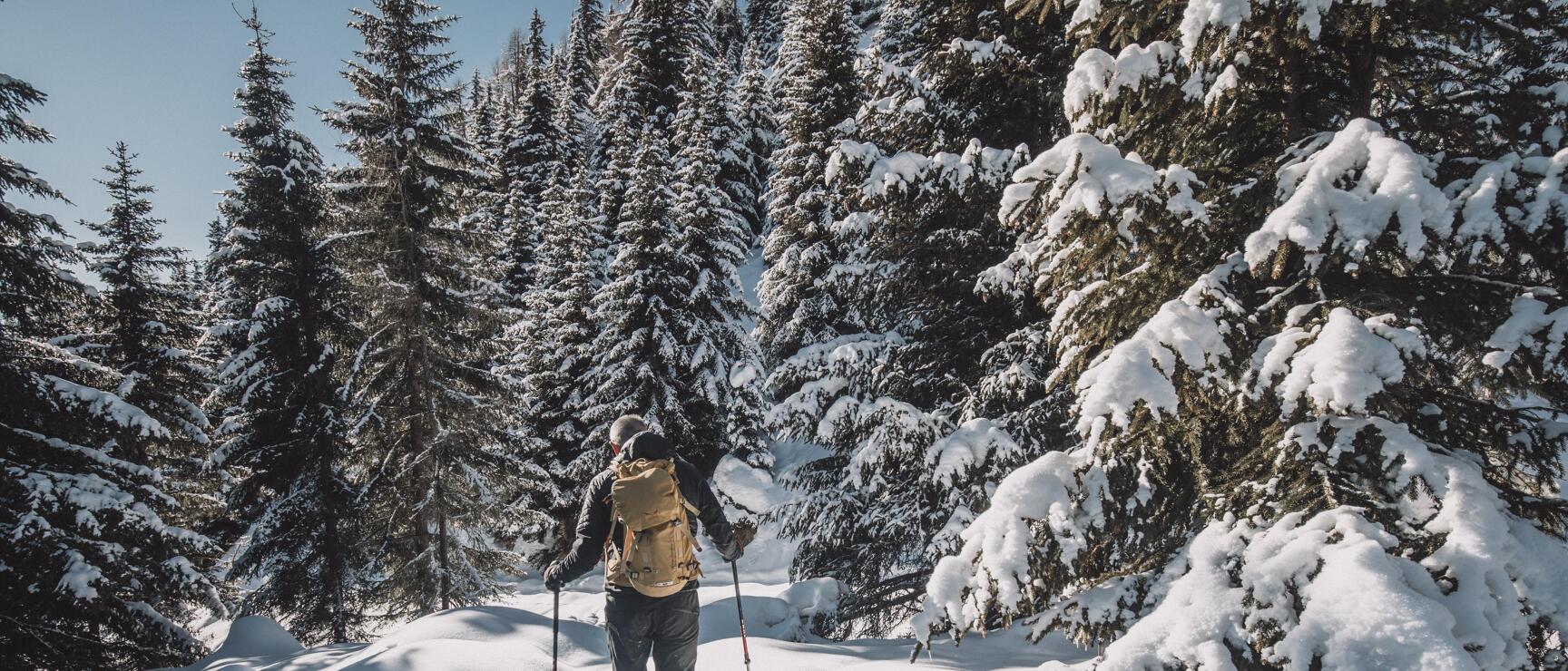
Snowshoe Hiking in Austria
Following winter's trails
Introduction
Whether you should embark on a snowshoe hike on your own depends on the area, your fitness level, your experience, and the weather and snow conditions.
If you go on a snowshoe hike with a national park ranger, there's a good chance you might spot one of the "Big Five of the Alps": ibex, golden eagle, ptarmigan, chamois, and bearded vulture. These elusive animals are rarely seen in winter, but the ranger knows the best times and places to spot them, for instance in the Hohe Tauern National Park.
They also know the names of the 3,000-metre / 9,800-foot peaks whose rugged, white summits tower into the sky. The Grossglockner and Grossvenediger, the two highest, are usually memorable even to first-time visitors. An added benefit of this adventurous snowshoe hike is the wonderful feeling of happiness as the everyday stresses gradually melt away.
Snowshoe hiking in Austria's provinces
Snowshoe hiking in Austria's regions
Did you know, that ...
... snowshoes already existed around 12,000 years ago? Ancient rock paintings prove it.
... the extended, moderate activity of snowshoeing boosts fat burning?
... snowshoeing's endurance training positively impacts the cardiovascular system?
... in Mongolia, 6,000-year-old snowshoes were found? They were wooden planks wrapped in fur.
Snowshoe tours through Austria
Well equipped for snowshoe hiking
Whether you set off alone depends on the area, your fitness level, experience and the weather. If you are unsure, it is best to book a guided tour – either solo with a guide or together in a group.Which equipment do you need?
Snowshoes (depending on body weight and snow type)
Poles with snow baskets
Waterproof hiking boots (ankle-high)
Gaiters (to keep snow out of your shoes)
Functional clothing (layering system: underwear, insulation, outer layer)
Waterproof jacket and trousers
Warm hat and gloves
Sunglasses and sun cream (snow reflection!)
Which snowshoes do you need?
It is best to strap your snowshoes onto hiking boots with sturdy, torsion-resistant treaded soles.
The larger the snowshoe, the less you sink into deep snow.
If you are planning tours in steeper terrain, smaller snowshoes are recommended.
Incidentally, walking is less strenuous with snowshoes that are not too wide.
The bindings should be easy to open and close with a quick-release fastener, even when wearing gloves.
Adjustable bindings have the advantage that they can be adjusted to fit different shoes.
What do you pack in your rucksack?
Insulated bottle with warm drink
High-energy snacks (nuts, bars, dried fruit)
First aid kit
Head torch (early darkness in winter)
Mobile phone with emergency numbers
Bivouac sack (emergency protection)
Lighter and pocket knife
Rubbish bag