365 Days of Leopold Museum
A must-visit in Vienna for art lovers
Introduction
Located in the MuseumsQuartier Vienna – one of the world's largest and most frequently visited art and cultural spots – the Leopold Museum is a key cultural centre of the city.
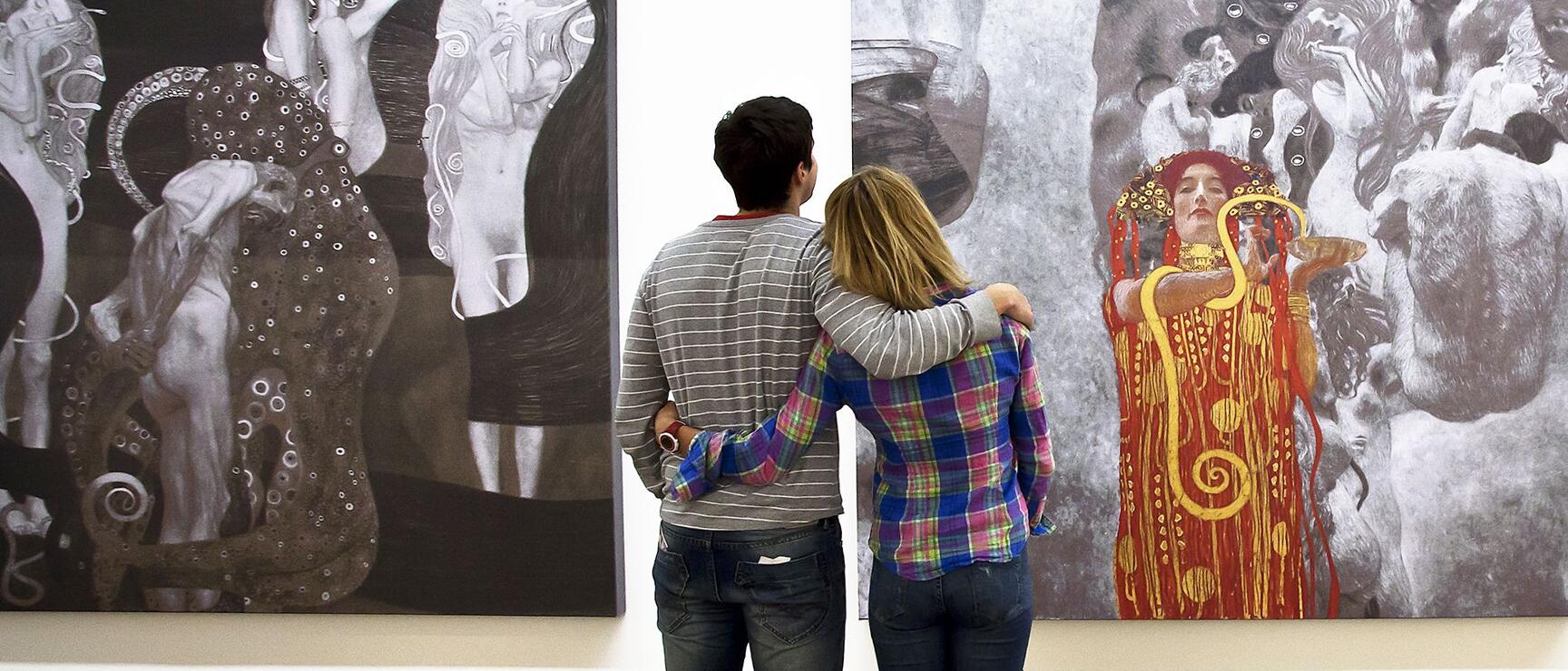
A treasure trove of Austrian art, it showcases an exceptional collection of more than 8,300 works from the late 19th and early 20th centuries, inviting you to explore the beauty and complexity of the era's artistic innovations, from expressive portraits to groundbreaking avant-garde works. The Leopold Museum is well-known for housing the world’s most significant collection of works by Egon Schiele, alongside masterpieces by Gustav Klimt, Oskar Kokoschka, and other key figures of Austrian Modernism.
The building's design by architects Laurids Ortner and Manfred Ortner is equally striking: a bright cube clad in white shell limestone from the Danube river, spanning over five floors, with a dragonfly-shaped lookout on the roof. Leopold Museum's bright, modern galleries provide an elegant setting to explore the radical ideas, expressive forms, and emotional intensity that defined Vienna’s art scene around 1900.
Why visit Leopold Museum
One of Vienna’s key cultural centres
It's their 25th birthday - and the museum celebrates it with outstanding special exhibitions
Explore Leopold Museum’s remarkable collection and immerse yourself in the atmosphere of Vienna around the Fin de Siècle
A marvellous view of Vienna from the MQ Libelle rooftop terrace
Leopold Museum houses the most extensive collection of modern Austrian art worldwide and takes you up close with greats like Klimt, Schiele, and Kokoschka.
Vienna 1900: The permanent exhibition
Rudolf and Elisabeth Leopold created a unique collection over the course of five decades. Their extraordinary passion for art enabled them to collect artists like Egon Schiele and Gustav Klimt – who, up to the 1960s, were considered taboo. With more than 220 works, they established the world’s most comprehensive Egon Schiele collection.
Leopold Museum's permanent exhibition Vienna 1900. Birth of Modernism creates a unique world of experience which affords complex insights into the fascination of Vienna around 1900 with Egon Schiele and Gustav Klimt and allows visitors to immerse themselves in the atmosphere of this vibrant time. Experience the splendour and wealth of this era’s artistic and intellectual achievements firsthand through the masterpieces of the Leopold Museum.
Herbert Boeckl - Hans Josephsohn
Since the Italian Renaissance, the increasingly prominent question of a hierarchy of the arts, one that fuelled, among other things, the rivalry between painting and sculpture, came to an end with the advent of modernism. In this exhibition, where the work of a sculptor encounters that of a painter, the intention is not to revive the debate in art-theoretical terms, but rather to stage a dialogue between two artistic personalities who, despite their differences in historical, spatial, and cultural contexts, reveal striking analogies both in formal aesthetics and in the phenomenology of their work.
Herbert Boeckl (1894–1966) and Hans Josephsohn (1920–2012) never met during their lifetimes, yet have fundamental parallels in their understanding of corporeality, materiality, and the process of form-finding.
Modern Fashion
This exhibition explores the development of Viennese fashion from around 1900 to approx. 1930. Henry van de Velde and Anna Muthesius heralded a revolution: The rejection of the corset and the introduction of the reform dress marked a significant paradigm shift in European women’s clothing.
The exhibition will focus on the fashion department of the Wiener Werkstätte, founded in 1911, and will shed light in particular on the fruitful exchange between Vienna and Paris, the fashion capital par excellence. Paul Poiret, the “King of Fashion” at the time, who worked closely with artists, maintained contact with the Wiener Werkstätte. Fashion designer Emilie Flöge traveled regularly to Paris to study current trends, and the Wiener Werkstätte participated in international exhibitions with its fashion and numerous other products.
Leopold Museum
Museumsplatz 1
1070 Vienna
Phone: +43 1 525 70 1555