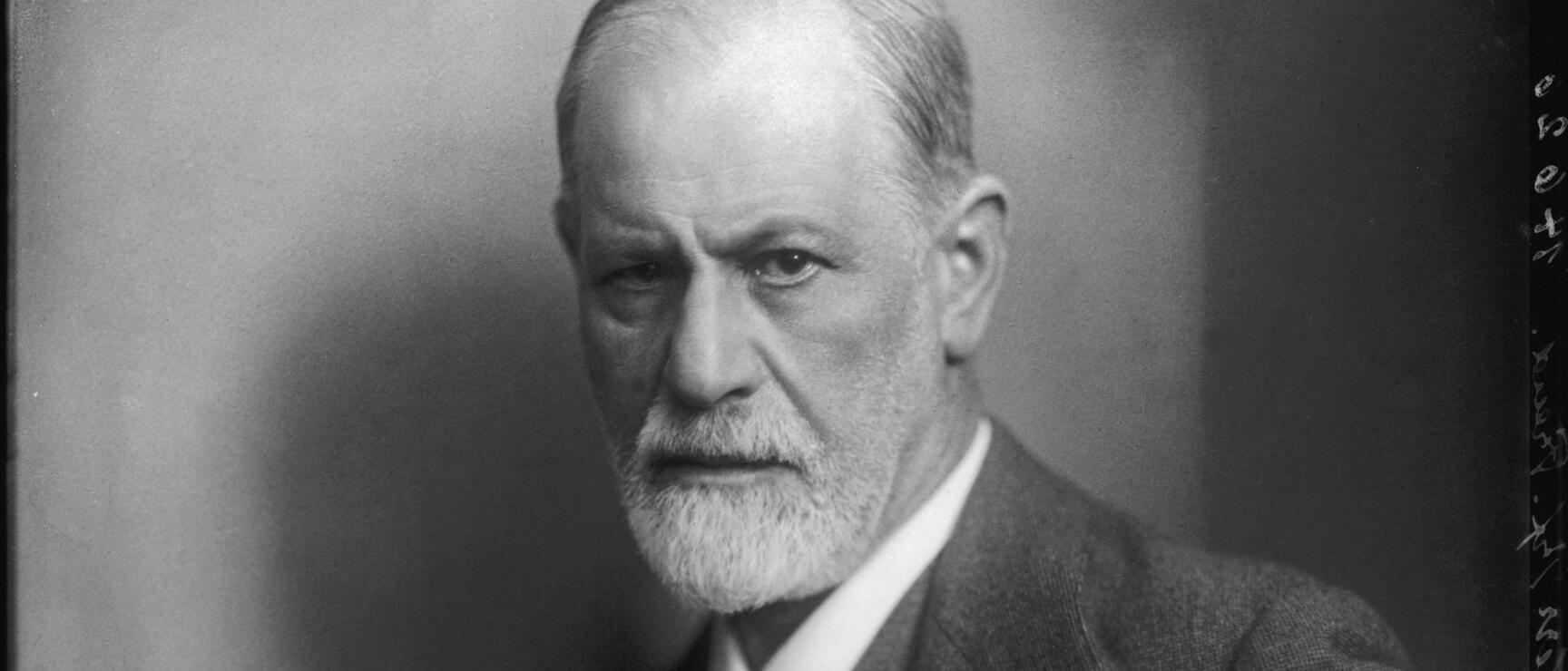
Sigmund Freud
Father of psychoanalysis – between everyday life in Vienna, the couch and cultural history

In 2026, Vienna marks the 170th anniversary of Sigmund Freud, the founder of psychoanalysis – in places where his thinking and research can still be felt today.

Sigmund Freud was born in 1856 in Freiberg in Moravia. In 1859, he moved with his family to Vienna, a city that would profoundly shape his thinking. After attending secondary school, he studied medicine at the University of Vienna, received his doctorate in 1881 and worked as a physician at Vienna General Hospital.

A study stay in Paris in 1885 with Jean-Martin Charcot marked a turning point in Freud’s understanding of illness and the human psyche. Back in Vienna, he set up his own medical practice and began to explore new approaches to understanding the mind. As early as 1882, he had secretly become engaged to Martha Bernays. As Freud was not yet financially secure and Martha had no dowry, the couple had to wait several years before marrying. Their long engagement became an intense long-distance relationship, sustained largely through letters. More than a thousand of these letters have survived, offering insight into Freud’s personal thoughts. Together, they had six children, including Anna Freud, who later gained international recognition and further developed her father’s work.

For almost five decades, Freud lived and worked at Berggasse 19 in Vienna’s 9th district. This address became the centre of his intellectual world. Here, he wrote key works such as The Interpretation of Dreams, published around 1900, which presented dreams as a gateway to the unconscious. The couch on which his patients lay became a symbol of psychoanalysis and the method of free association. Freud’s theories attracted international attention but also strong opposition, particularly because of his emphasis on sexuality as a fundamental psychological drive. Despite this, his work gained recognition: in 1902 he was appointed associate professor, and in 1919 full titular professor at the University of Vienna. In 1924, the City of Vienna made him an honorary citizen, and in 1930 he received the Goethe Prize of the City of Frankfurt.

In 1938, persecution by the National Socialist regime forced Sigmund Freud to emigrate to London, where he died on 23 September 1939. His work continues to influence far more than medicine alone. Literature, art, film and philosophy still draw on the ideas of the founder of psychoanalysis. The foundations of this legacy were laid in Vienna – a city where science, everyday life and culture remain closely intertwined.

Sigmund Freud
Born:6 May 1856 in Freiberg, Moravia (today Příbor, Czech Republic)
Died:23 September 1939 in London
Birth nameSigismund Schlomo Freud
Profession:Neurologist, physician and founder of psychoanalysis
Most influential work:The Interpretation of Dreams

On the Bellevuehöhe in the Vienna Woods, Freud had the decisive insight for his theory of dream interpretation in 1895.

Meet Sigmund Freud

‘Let the biographers struggle – we do not want to make it too easy for them. Everyone will believe their own view of the “development of the hero” to be correct, and I already look forward to how mistaken they will be.’

Letter to his wife Mrs. Martha Bernays

Tracing Freud in Austria

Original sites of psychoanalysis

Sigmund Freud Museum Vienna

A doorbell, a staircase, a doorway: a visit to the Freud Museum Vienna begins exactly where Sigmund Freud once received his guests. He lived and worked at Berggasse 19 for almost 50 years, developing his ideas while balancing family life, research and the city around him. Today, the original rooms offer insight into this everyday world. Since the renovation in 2020, all areas are accessible for the first time, from the waiting room to the private living quarters.

Photographs, objects and personal traces tell the story of Freud’s life and work and the development of his ideas on dream interpretation. Although the original couch is now in London, it can be virtually returned to its place via augmented reality. The museum is complemented by Europe’s largest psychoanalysis library, a research institute, and a programme of temporary exhibitions and contemporary art.

Freud and Vienna's coffee house culture

After long days of analysis, Sigmund Freud would retreat to the coffee house. At Café Landtmann, he met patients such as Anna von Lieben, played Tarock and let ideas flow – part of Vienna’s intellectual network around 1900.

Fun facts: the person behind psychoanalysis

Not everything about Sigmund Freud fits neatly into textbooks. These insights highlight unusual episodes, personal habits and biographical details that reveal the many layers of the founder of psychoanalysis.

Freud’s couch: the origin of free association

A gift that made history: around 1890, Sigmund Freud received a couch from his patient Madame Bevenisti in Vienna. In his practice at Berggasse 19, it became central to his work. As patients lay down and spoke freely, Freud developed the method of free association – a cornerstone of psychoanalysis. The couch travelled with him to London in 1938 and is now on display at the Freud Museum there. In Vienna, it lives on as a virtual reconstruction.

Freud’s cigars: between habit and self-control

Cigars were as much a part of Freud’s daily routine as thinking and writing. He began smoking in his twenties and later consumed more than 20 a day. Freud openly acknowledged his dependence, linking smoking to concentration and creative energy. Even after developing serious cancer of the jaw, he continued to smoke. The cigar became part of his identity – a symbol of discipline, pleasure and defiance of medical advice.

Breaking taboos: drives and psychoanalysis

When Freud began writing about sexuality and the unconscious, he deliberately challenged social taboos. He placed sexuality at the centre of human development from birth, questioning the moral values of his time. Concepts such as the Oedipus complex, incest wishes and repressed drives met with strong resistance. Even when C. G. Jung suggested interpreting libido in a less sexual way, Freud held firm. In Totem and Taboo, he described taboos as driving forces of culture and morality. For Freud, understanding humanity meant confronting its darker sides.

Freud and cocaine: curiosity and risk

In the 1880s, Freud’s curiosity led him to research cocaine. As a young doctor in Vienna, he experimented on himself and patients, promoting the substance in his essay On Coca (1884) as a remedy for fatigue, depression and morphine addiction. Serious side effects, addiction and the death of a close colleague eventually brought disillusionment. Freud later referred to this period as a ‘youthful error’ and turned his focus fully to the study of the psyche.

Friendships and intellectual exchange

Freud maintained close relationships with writers, artists and intellectuals. Particularly significant was his long friendship with Stefan Zweig, with whom he exchanged ideas on literature, psychology and contemporary issues; Zweig later delivered Freud’s funeral address. Freud also corresponded with Arthur Schnitzler, Thomas Mann, Hermann Hesse and Romain Rolland. A notable, if brief, encounter took place with Gustav Mahler in 1910. Freud admired Rembrandt for his psychological depth and, in London in 1938, met Salvador Dalí, whose technique impressed him.

Anna Freud: carrying the legacy forward

Anna Freud (1895–1982), Sigmund Freud’s youngest daughter, was born in the same year as psychoanalysis itself. To her father, she was more than a daughter – he saw her as his successor. Trained in Vienna and analysed by Freud himself, she went on to shape the field of child psychoanalysis. Together, they founded the Vienna Psychoanalytic Society. After their emigration in 1938, Anna cared for her father in London during his illness and continued to develop his work. She is regarded as a pioneer of modern child analysis.

FAQs

The Sigmund Freud Museum is located at Berggasse 19 in Vienna's 9th district. Freud lived and worked here for almost 50 years, developing the foundations of psychoanalysis.

Among Freud’s most influential works written in Vienna are The Interpretation of Dreams (1900), The Psychopathology of Everyday Life (1901), Totem and Taboo (1910–1913) and The Ego and the Id (1923). Many were created at Berggasse 19.

Freud’s couch is famous because he used it as a key tool in psychoanalysis. Given to him around 1890 by his patient Madame Bevenisti, it enabled the method of free association and became a global symbol of psychoanalysis.

Freud was a regular at cafés such as Café Landtmann and Café Central. These coffee houses were meeting places for intellectuals and offered spaces for relaxation, card games and conversation.

Sigmund Freud lived in Vienna for almost 50 years. From 1891 until 1938, he lived and worked at Berggasse 19 before fleeing to London due to Nazi persecution.

You might also like

Discover the Best of Austria

Sign up for our newsletter and enjoy exclusive access to:

  • Insider tips and itineraries for your next trip to Austria

  • Traditional recipes

  • Must-see events and cultural highlights

  • Interesting stories about Austria