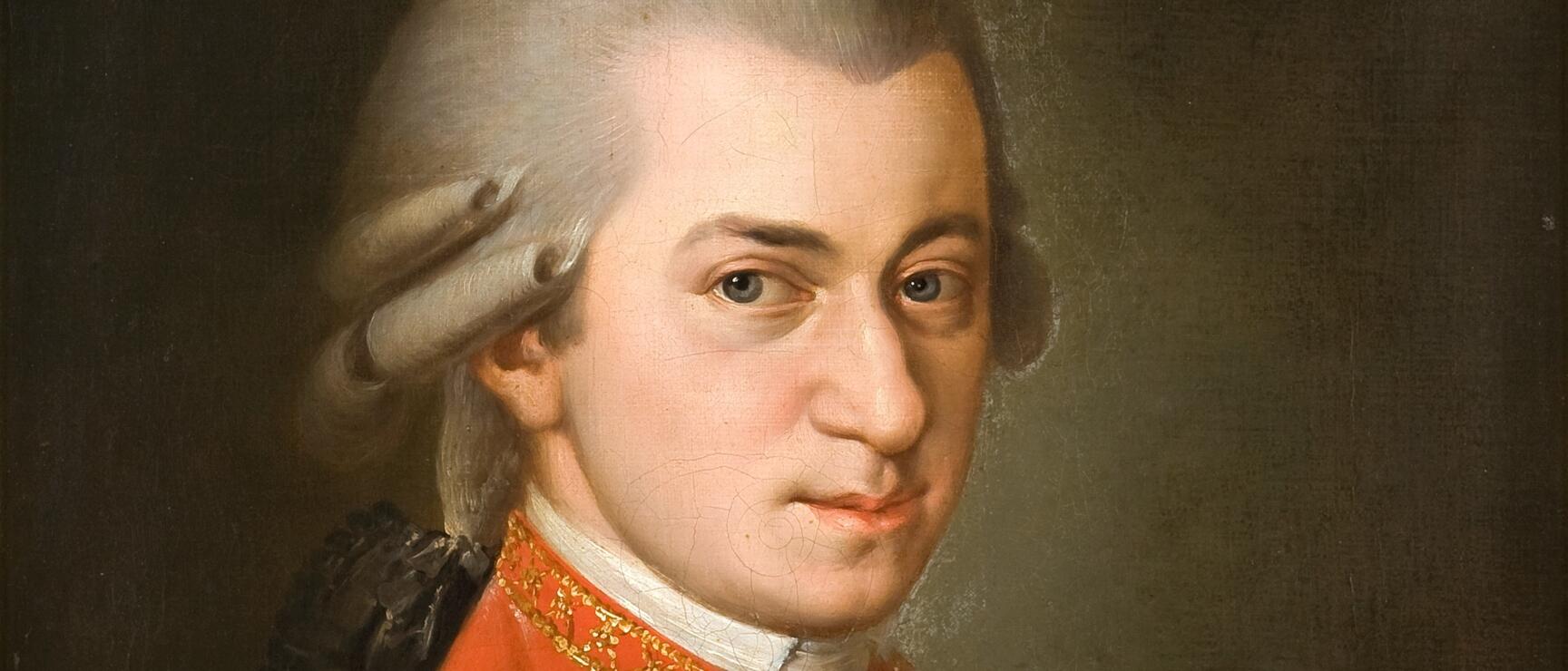
Wolfgang Amadeus Mozart
From Salzburg to Vienna: Mozart's life as composer and icon of the Viennese Classical period
Introduction
Wolfgang Amadeus Mozart was a musical genius who started composing at the age of five. A year later, he was touring Europe, astounding queens, kings, and nobility with his talent. Despite his short life - he passed away at just 35 - he left behind 626 works, including symphonies, operas, chamber music, concertos, and masses. The Magic Flute and Eine kleine Nachtmusik are among his most iconic pieces.
Mozart was a workaholic, said to have used 8 km (26 ft) of manuscript paper for his compositions. Known as “Wolferl” by his family, he was impulsive, chaotic, incredibly humorous, and full of zest for life, as revealed in the many letters he wrote to friends and family. As a child, he travelled with a small piano, always carrying grammar books, fine performance clothes, tea, sugar, and a first aid kit. Travelling meant hours of carriage rides on bumpy roads. Mozart made 17 trips in total, spending nearly ten years of his life on the road.
These eventful years coincided with operas that shaped music history: Idomeneo premiered in 1781 at the Munich Cuvilliés Theatre, regarded as his first major opera. In Vienna, he brought his famous Da Ponte operas to the stage in Vienna: Le nozze di Figaro (1786), Così fan tutte (1790) and - shortly before his death - The Magic Flut (1791).
Salzburg was Mozart's birthplace and first place of work, but Vienna is where he was musically shaped and became one of the most influential composers of the Viennese Classical period. In Domgasse 5, now the Mozarthaus Vienna, Mozart spent his most productive years. He earned an average of 5,000 guilders (equivalent to about 150,000 Euros today) per year.
Despite his success, he remained very much a human: impulsive, witty, chaotic, full of life, a prankster, a friend and a brother. He drank almond milk at the Café Tomaselli in Salzburg, bowled with his sister Nannerl, tried dark beer at Stieglbräu, and enjoyed social evenings.
His friendship with Joseph Haydn brought him the highest recognition. Haydn called him the greatest composer he had ever known. Both were members of the Freemason lodge — a circle of art, enlightenment, and exchange.
Mozart spent his last ten years in Vienna. Here, he married, became a father, and died in 1791. His sudden death is still somewhat a mystery. Just before he died, he believed he had been poisoned, but scientifically, this was ruled out. His music continues to inspire and touch people around the world to this day.
The Salzburger Mozartkugel comes in many variations — but only Konditorei Fürst produces the original: a marzipan centre, coated in nougat and dark chocolate.
270 years of Wolfgang Amadeus Mozart: Salzburg is dedicating an anniversary year full of music to its most famous son. In addition to major concert series, such as the 70th Mozart Week, special venues invite visitors to discover the many facets of Mozart's music.
Impressions of Wolfgang Amadeus Mozart
"… because I do not have a single symphony with me, I am writing a new one from scratch…"
Wolfgang Amadeus Mozart, Linz, 31 October 1783 to Leopold Mozart
In Mozart's footsteps through Austria
Mozart's most famous works at a glance
Events: Experience Mozart throughout the year
Throughout the year, concerts, festivals, and special programmes celebrate the musical legacy of Wolfgang Amadeus Mozart. The following events all bring his works and the world of the Viennese Classical period to life.Nannerl & Constanze: The women behind Mozart
Maria Anna “Nannerl” Mozart was Wolfgang’s first great musical partner. Born in the Getreidegasse in Salzburg, she was considered a musical genius in her own right. Her childhood was shaped by music, puzzles, and travel, supported by a mother who fostered education and curiosity in her children. Nannerl shone on stages in Paris, London, and at the courts of Europe - admired by Empress Maria Theresa - yet social constraints soon forced her talent into the background. Later, she taught in Salzburg and St. Gilgen, composed her own works, and maintained an intensive correspondence with her brother. Her marriage to Johann Baptiste von Berchtold brought her security, but within a setting that allowed women little artistic freedom. She lived in St. Gilgen for many years, cared for a large patchwork family, and returned to Salzburg after her husband’s death.
Constanze Mozart became Wolfgang’s closest ally and a smart manager by his side in Vienna. She inspired him artistically, supported him organisationally, and sang demanding parts, such as the soprano solo in the Great Mass in C minor. After his death in 1791, she assumed responsibility: she organised concerts, travelled with his compositions, negotiated with publishers, and contributed to the first Mozart biography. Constanze also ensured the completion of the Requiem, thereby playing a decisive role in preserving and shaping the legacy of Mozart’s music.
Mozart Fun Facts: Inside the world of a musical genius
Wolfgang Amadeus Mozart was more than a genius of the Viennese Classical period: his everyday life, travels, and quirks tell fascinating stories — far beyond his music. Did you know that…The Viennese Classic
The Viennese Classical period (1770–1830), also called the First Viennese School, is a style of European art music, represented primarily by composers Joseph Haydn, Wolfgang Amadeus Mozart, and Ludwig van Beethoven.
The development of the Viennese Classical style was significantly influenced by the years following Mozart’s move to Vienna. Here, Joseph Haydn and Mozart exchanged artistic ideas and inspired each other to create innovative compositions, particularly string quartets and symphonies, which were the popular genres of the time.
By the way: In Vienna, 10,000 music fans enjoy live classical music every night – something unique in the world.
The culinary side of the composer
Wolfgang Amadeus Mozart loved music, but also small pleasures in everyday life. At the traditional Café Tomaselli in Salzburg, just a few steps from his birthplace, he enjoyed drinking almond milk — a ritual that gave him a moment of calm in his busy daily routine. He also loved hearty meals: his favourite pairing was liver dumplings with sauerkraut and a dark beer. In his sister Nannerl’s diary, it is recorded how the two of them spent sociable hours bowling at the Stieglbräu.
In a letter to his wife Constanze from Frankfurt am Main in October 1791, Mozart wrote: "At half past five I went out the parlour door — and took my favourite walk across the glacis to the theattre — what do I see? — what do I smell? — Don Primus is here with the carbonades! — che gusto!"
These moments reveal a man who intertwined pleasure, sociability, and everyday life into his world.