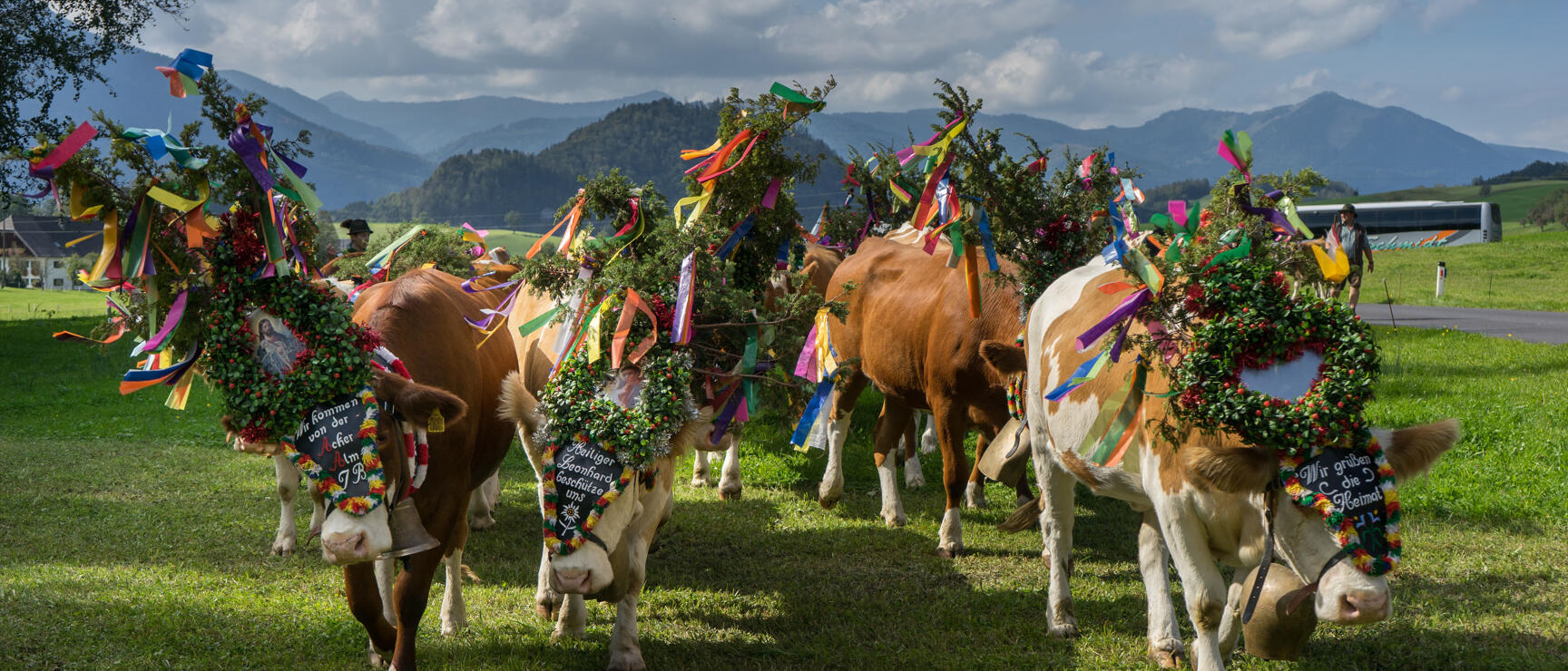
Cattle Processions in Austria
Welcome to the festive customs in the mountain regions!
Introduction
Depending on the weather, the Alpine summer lasts from June to October. The return of the animals and their keepers to the valley is celebrated in many places with spectacular Almabtrieb processions and traditional customs.
Each year in Austria, farmers, herders and dairymaids lead their animals from the valley up to the mountain pastures in spring. High in the Alps, cows, sheep, goats and horses find lush meadows and wild herbs — a particularly rich and nutritious source of food. Alpine farming has been part of life in the Alps for centuries. On many mountain pastures, grazing land is traditionally used by livestock during the summer, as it has been for generations.
When the days grow cooler and the alpine summer comes to an end, the animals return to the valley. Many cattle drives are accompanied by music, regional markets and culinary specialities. Visitors can experience Austrian traditions, a lively atmosphere and traditional autumn festivals.
Note on event dates
This overview provides information on cattle drives across Austria's provinces. While we strive to keep all details up to date, the list may not be complete and all information is provided without guarantee.
As dates and event details can change at short notice, we recommend checking the website of the respective region or contacting the local tourist board directly before making plans.
Cattle drives in Carinthia and Upper Austria
Carinthia
Bad Kleinkirchheim
12 September 2026
Upper Austria
Bad Ischl Salzkammergut/ Rettenbachalm
End of September/ beginning of OktoberDachstein Salzkammergut/ Gosau, Moosalm
19 September 2026
Cattle drives in SalzburgerLand
Bruck Fusch am Großglockner 05 September 2026
Filzmoos 14 September 2026
Fuschlsee Region/ Gruberalm-Hintersee
19 September 2026Gasteinertal/ Sportgastein
12 September 2026 (sheep drive)Krimml 19 September 2026
Pinzgau/ Maishofen 19 September 2026
Radstadt 11 September 2027 (every other year)
Rauris 12 September 2026
Wagrain 19 September 2026
Cattle drives in Styria
Joglland Waldheimat / Hochwechsel
12 September 2026Köflach
Lipizzaner stallions drive, 12 September 2026Lachtal/ Hochegg
26 September 2026Ramsau am Dachstein/ Walcheralm
25 & 26 September 2026
Cattle drives in Tirol 1/2
Achensee/ Pertisau 16, 18 & 20 September 2026
Alpbachtal 19 & 26 September 2026
Hall-Wattens/Absam 12 September 2026
Ferienregion Imst/ Tarrenz
13 September 2026 (sheep drive)
Kitzbüheler Alpen
Brixen im Thale 19 September 2026
Ferienregion Hohe Salve/ Hopfgarten
26 September 2026Kirchberg in Tirol 19 September 2026
Pillerseetal 5 & 19 September 2026, 3 October 2026
Westendorf im Brixental 19 September 2026
Kufsteinerland
Cattle drives in Tirol 2/2
Pitztal/ Jerzens 12 & 13 September 2026
Tannheimer Tal 21 September 2026
Wilder Kaiser/ Söll 19 September 2026
Wildschönau/ Aufach 19 September 2026
Tiroler Oberland
Ried 5 September 2026
Pfunds (cattle & horses) 12 September 2026
Pfunds (sheep) 25 & 26 September 2026
Zillertal
Fügen-Kaltenbach 19 September 2026
Gerlos 26 September 2026
Hintertux 26 September 2026
Zell am Ziller 26 September 2026
Cattle drives in Vorarlberg
Au-Schoppernau 22 August 2026
Schwarzenberg 12 September 2026
Dornbirn 19 September 2026
Kleinwalsertal 19 September 2026
Montafon
Alpe Gafluna, Silbertal 4 September 2026
Alpe Fresch, Silbertal 5 September 2026
Alpe Nova und Alpe Zamang, St. Gallenkirchen 5 September 2026
Alpe Vergalden, Gargellen 5 September 2026
Alpe Lün, Vandans 5 September 2026
Rinderalpe Nova, St. Gallenkirch 12 September 2026
Alpe Spora/Vollspora/Latschätz/Tilisuna und Hora, Tschagguns 12 September 2026
Alpe Valzifenz, St. Gallenkirch 12 September 2026
Alpe Valschaviel, Gaschurn 26 September 2026
Schafscheide Garnera, Gaschurn 26 September 2026
Did you know...?
Cattle drive in the Wildschönau
The cattle spend their summer grazing on 46 Alpine pastures at around 2,000 metres above sea level, high above the Wildschönau valley. Before the Alpine summer comes to an end, the herders uphold a cherished tradition: the Gru-Nacht, the final night on the mountain, celebrated with hearty food and good company.
But the herders need a bit of rest — because on the day of the Almabtrieb, they guide the elaborately and colourfully decorated cattle safely back down into the valley. There, the animals are welcomed with music and festivities. A farmers’ and crafts market adds to the lively atmosphere, offering regional specialities such as Brodakrapfen, Schmalznudeln and Krautinger — a local schnapps made from turnips.
From the Gruberalm down to the valley in the Fuschlsee area
The Gruberalm in Hintersee, situated at around 1,000 metres above sea level, is an especially idyllic spot. Every September, the dairymaids and herdsmen of SalzburgerLand take on an additional task: they craft the ornate headpieces that the cows wear during the Almabtrieb. By mid-September, the big day arrives — with celebrations in the morning, followed by the gathering and decorating of the cattle at midday. In the afternoon, everyone who wants to take part sets off together on the journey down into the valley.
Peace then returns to the Gruberalm. According to legend, after the Alpine summer, the Kasamandl — a mountain spirit — moves into the huts and stays there until the next summer begins.
Haflinger stallion drive in Ebbs
In Ebbs, Haflinger horses are raised in close harmony with nature — and that includes spending five months of the year on Alpine pastures. On the second Saturday in October, the "young wild ones" return to the farm. Each of the roughly 50 stallions is led by a Haflinger breeder.
Anyone wishing to join the final stretch of the procession can gather at the Oberwirt inn in Ebbs. From there, the parade continues to the Fohlenhof arena. After the young stallions are formally presented, the Alpine summer draws to a festive close.
The homecoming of the Lipizzaners in Piber
The Austrian Lipizzaner stud farm is based in Piber near Köflach in Styria. To help develop sure-footedness as well as strong tendons and joints from an early age, the young stallions — aged between one and three — spend the summer months on the Stubalm at 1,500 metres above sea level. In September, the grey-black horses, adorned with simple decorations, return to the valley. Before arriving back at the stud in Piber, they receive a blessing in the courtyard of the Maria Lankowitz pilgrimage church.
The Almabtrieb is celebrated in Maria Lankowitz, Köflach and Piber with music and regional delicacies.
A spectacle of sheep
Each summer, the sheep and lambs graze on the Hinterberg-Alm, as tradition dictates. Their journey back to the valley takes over three hours — including regular breaks for water. Some are decorated with sprigs of spruce and colourful paper flowers. Real flowers wouldn’t last long — the sheep would simply eat them.
During the Tarrenzer Schafschied, around a thousand sheep pass through the narrow Trujegasse. The animals then gather in the Bangert, the large meadow behind the Gasthof Sonne, where they are returned to their rightful owners. That’s where the name comes from: at the Schafschied, the sheep are ‘separated’ and sorted.
While all this is happening, spectators are free to enjoy the festivities. Local inns serve regional specialities — including dishes made with sheep — and music fills the air at various spots throughout the village.
Why is Alpine farming so important?
Traditions and customs in Austria
In Austria, the preservation of traditions and customs is closely linked to cultural heritage. Practices such as Almabtriebe, traditional festivals and regional crafts are part of local culture.
Celebrations such as maypole festivals, Easter and Christmas customs strengthen community spirit and encourage collective care for the region.
UNESCO’s Intangible Cultural Heritage recognises traditional rituals, customs and craftsmanship passed down through generations. For visitors, experiencing these living traditions offers an authentic insight into Austrian culture — and helps reinforce local identity.