The Danube
Always with the river in view: From the Donausteig to the Wachau and on to Vienna
Introduction
The Schlögener Schlinge is the Danube’s most famous meander and a masterpiece shaped by evolution – the result of wind, water and millions of years of time. The Romans already used the river as a waterway, bringing goods and ideas deep into the country. The Danube also created a mild microclimate and fertile soils that attracted settlers to its banks early on. Castles, abbeys and towns were built here, shaping a cultural landscape unlike any other.
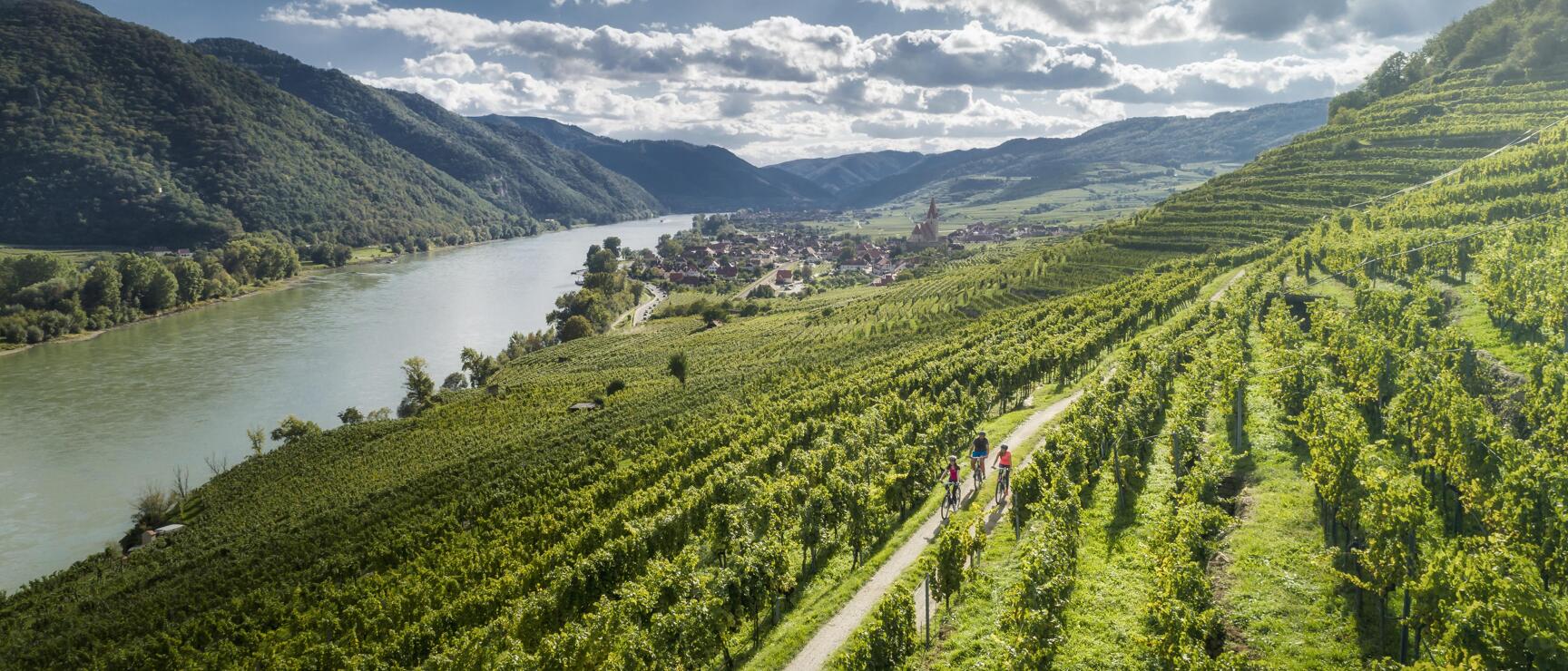
And then there is the remarkable variety of experiences along the river. Between the baroque splendour of Melk Abbey and the quiet beauty of the Wachau with its terraced vineyards lies a landscape so exceptional that it has been recognised as a UNESCO World Heritage Site. Further east, the Danube approaches Vienna, where it meets urban ease and centuries of history before continuing towards the Donau-Auen National Park, with its floodplain forests, side channels and network of accessible trails.
Whether travelling by boat, bike or on foot, one thing quickly becomes clear: the Danube is not simply a destination. It is an invitation to go with the flow – between culture, the present moment and whatever lies ahead.
"The Blue Danube" – Johann Strauss the Younger’s waltz began its triumphant journey around the world shortly after its premiere on 15 February 1867. Today, it is Austria’s unofficial national anthem and a permanent addition to the programme of the New Year’s Concert in the Golden Hall of the Vienna Musikverein.
Meet the Danube
Top highlights
Cities and places
Top events
Unique places to stay
Donau-Auen National Park
The Donau-Auen National Park stretches from Vienna to the point where the River March meets the Danube at the Slovak border. Along this 36-kilometre (22-mile) section, the Danube shapes floodplain forests, riverbanks and side channels, creating a habitat for more than 60 species of fish, as well as kingfishers, white-tailed eagles, beavers, European pond turtles, rare orchids and countless insects.
The protected area is freely accessible, although visitors are asked to stay on marked hiking trails and designated cycling routes. Guided walks and inflatable boat tours led by National Park rangers offer a particularly immersive way to experience the landscape and its wildlife.