Austria by Train Itinerary
From Vienna to Bregenz in 7 Days
Introduction
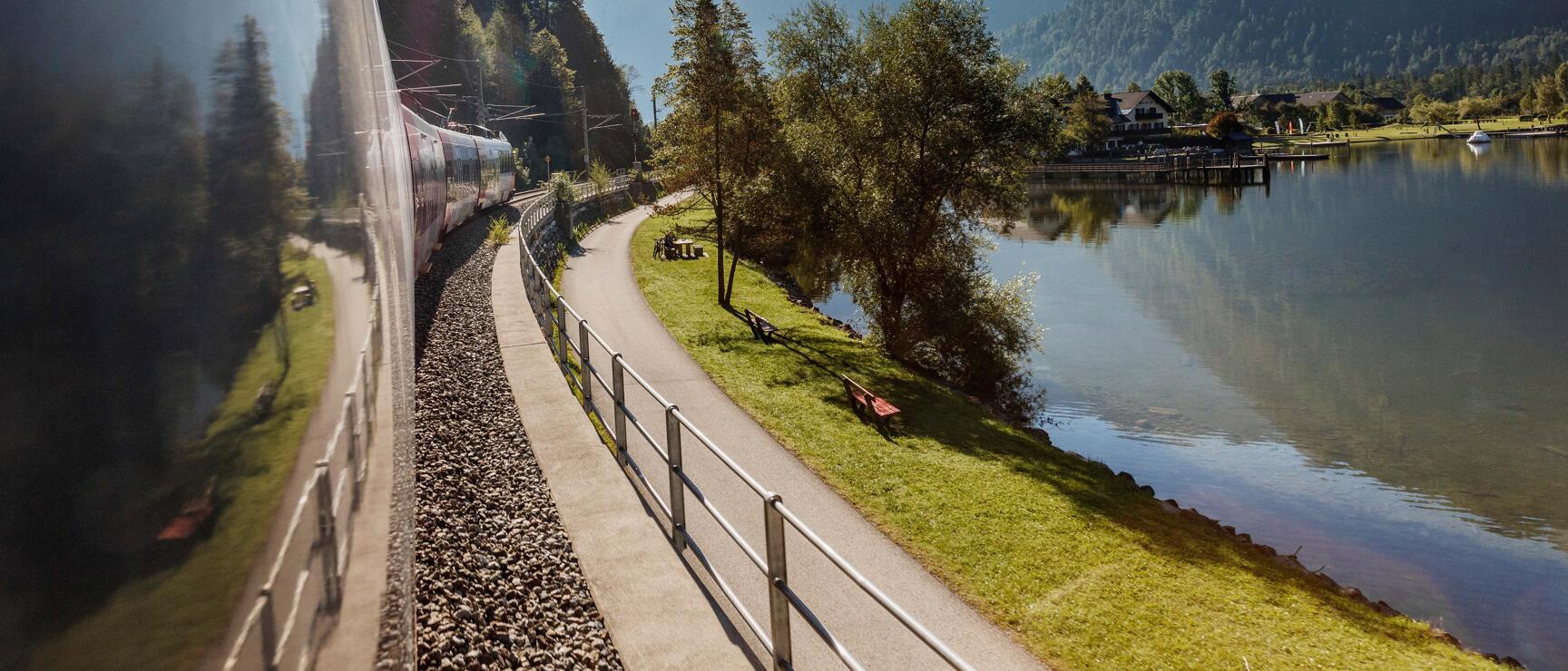
A rail journey links Austria's cities, lakes and Alps. The 7-day route runs from Vienna to Bregenz, and you can just as easily plan it from west to east. Many of the stops are only a few hours apart by train. Austria's easternmost and westernmost borders are 573 kilometres apart. In the regional capitals, the stations are central and well connected to local public transport, so you have time to explore each stop between train journeys.
From Vienna, the route heads via Linz and Salzburg to the Salzkammergut and on to Lake Achensee. Innsbruck comes next, before the train crosses the Alps into Vorarlberg and on to Bregenz on Lake Constance. Along the way, cities, lakes and mountain scenery pass by the train window.
7 days, 7 stops – plan your own route
This itinerary is meant as inspiration and can't be booked as a package. Plan each stage yourself and book trains and accommodation to suit you.
All stages and journey times
Here's how much time to allow for each leg of the 7-day itinerary. The only change is between Salzburg and Bad Ischl.
Vienna – Linz / approx. 1 hr 15 min / Highlights in Linz
Linz – Salzburg / approx. 1 hr 10 min / Culture in Salzburg
Salzburg – Bad Ischl / approx. 1 hr 55 min / Highlights in Bad Ischl
Bad Ischl – Salzburg (return) / approx. 1 hr 55 min
Salzburg – Jenbach, then the Achensee Railway / approx. 1 hr 45 min + approx. 45 min / Lake Achensee
Jenbach – Innsbruck / approx. 25 min / Highlights in Innsbruck
Innsbruck – Bregenz / approx. 2 hrs 30 min / Tours in Bregenz
Day 1: Vienna
Vienna is an imperial city, shaped by grand landmarks such as Schönbrunn Palace, the Hofburg and St Stephen's Cathedral. Along the Ringstrasse, the State Opera, Parliament and City Hall stand one after another. Imperial heritage and Art Nouveau sit side by side. From the Hauptbahnhof (main station), the underground takes you to the city centre in just a few minutes.
Vienna loves music and lives it. Every evening, 10,000 music lovers listen to live classical music, and more than 15,000 events across a range of genres fill the city's concert calendar each year. One of Vienna's great music venues is the Vienna State Opera. A guided tour of around 40 minutes tells you more about the building's history and how the house is run.
Vienna's musical and cultural highlights
Day 2: Linz
Train journey Vienna – Linz: approx. 1 hr 15 min
Linz is all about art, technology and new media: the Ars Electronica Center and the Lentos showcase different art forms and perspectives. From the main station, the tram gets you to the Hauptplatz (main square) in a few minutes. From there, the Lentos and the Ars Electronica Center are within walking distance, separated only by the Danube.
Right by the river, the harbour district is home to Mural Harbor, a large open-air graffiti gallery with more than 300 works by artists from around 40 countries. The site can only be visited on a guided tour.
When it comes to food, Linz is closely linked to the Linzer Torte: its recipe was first mentioned in 1653 and is considered the oldest known cake recipe in the world.
Sweet treats from Linz
Day 3: Salzburg
Train journey Linz – Salzburg: approx. 1 hr 10 min
Salzburg's Old Town has been a UNESCO World Heritage Site since 1996. Within a small area you'll find Hohensalzburg Fortress, Getreidegasse with Mozart's Birthplace and Salzburg Cathedral, all key sights for a day visit. Salzburg Hauptbahnhof is about a 15-minute walk from the Old Town.
Salzburg's best-known palaces date from the era of the prince-archbishops in the 17th and 18th centuries. Hellbrunn Palace was built as a pleasure palace for entertainment and amusement.
Prince-Archbishop Wolf Dietrich had Mirabell Palace built for Salome Alt and their children. Leopold Mozart and his children Wolfgang and Nannerl once performed in its Marble Hall. The Mirabell Gardens are one of the Salzburg filming locations of the Hollywood musical "The Sound of Music".
Alongside art and culture, Salzburg is also known for its food and traditional dress, and from the Mönchsberg you can look out across the city.
Typically Salzburg
Day 4: The Salzkammergut
Train journey Salzburg – Bad Ischl: approx. 1 hr 55 min
From Salzburg, change at Attnang-Puchheim for Bad Ischl. The Kaiservilla recalls the days when the emperor spent his summers here, and every summer the Lehár Festival brings operetta to the stage.
From Bad Ischl, trains and buses take you to other places in the Salzkammergut, such as Lake Fuschl, Lake Mondsee or Lake Wolfgang. This makes it easy to add a swim, a boat trip or an excursion into the surrounding mountains.
To find out more about the region's salt history, visit the Salzwelten salt mines in Hallstatt or Altaussee. Then it's back to Salzburg.
More to discover in the Salzkammergut
Day 5: Lake Achensee in Tirol
Train journey Salzburg – Jenbach: approx. 1 hr 45 min
From Salzburg, continue to Jenbach in Tyrol, where you change to the Achensee Railway. Opened in 1889, this steam-powered cog railway runs seasonally from May to October and takes around 45 minutes to reach Lake Achensee. Jenbach station is also the starting point of the Zillertal Railway.
A boat trip across Lake Achensee links several villages on its shores. In Pertisau, hiking trails lead into the Karwendel Nature Park. You can also swim at Lake Achensee or try water sports such as sailing and windsurfing.
Continue through Tirol by train
Day 6: Innsbruck
Train journey Jenbach – Innsbruck: approx. 25 min
From the main station, it's about a 10-minute walk to the Old Town and the Golden Roof. From the city centre, the Hungerburgbahn funicular takes you up to Hungerburg at 860 metres. With three lifts, you can reach Top of Innsbruck on the Hafelekar at 2,256 metres in under 30 minutes. From there, it's a further 10 to 15-minute walk to the Hafelekar summit at 2,334 metres.
You can also fit some culture into this stage: Ambras Castle is home to Archduke Ferdinand II's Chamber of Art and Curiosities, among other things.
Culture and nature near Innsbruck
Day 7: Bregenz
Train journey Innsbruck – Bregenz: approx. 2 hrs 30 min
The capital of Vorarlberg sits right on Lake Constance and is best known for the Bregenz Festival and its floating stage on the lake. The Kunsthaus Bregenz shows contemporary art.
From the Pfänder, Bregenz's local mountain, the panoramic view takes in more than 240 Alpine peaks in Austria, Germany and Switzerland. The valley station of the Pfänderbahn cable car is about a 15-minute walk from Bregenz station, or around 7 minutes from the harbour. The cable car then takes six minutes to climb to more than 1,000 metres above sea level.
Excursion boats sail on Lake Constance, and several lidos line the shore.
For the return journey to Vienna, there's a direct Railjet service. The journey takes around 7 hours 20 minutes.