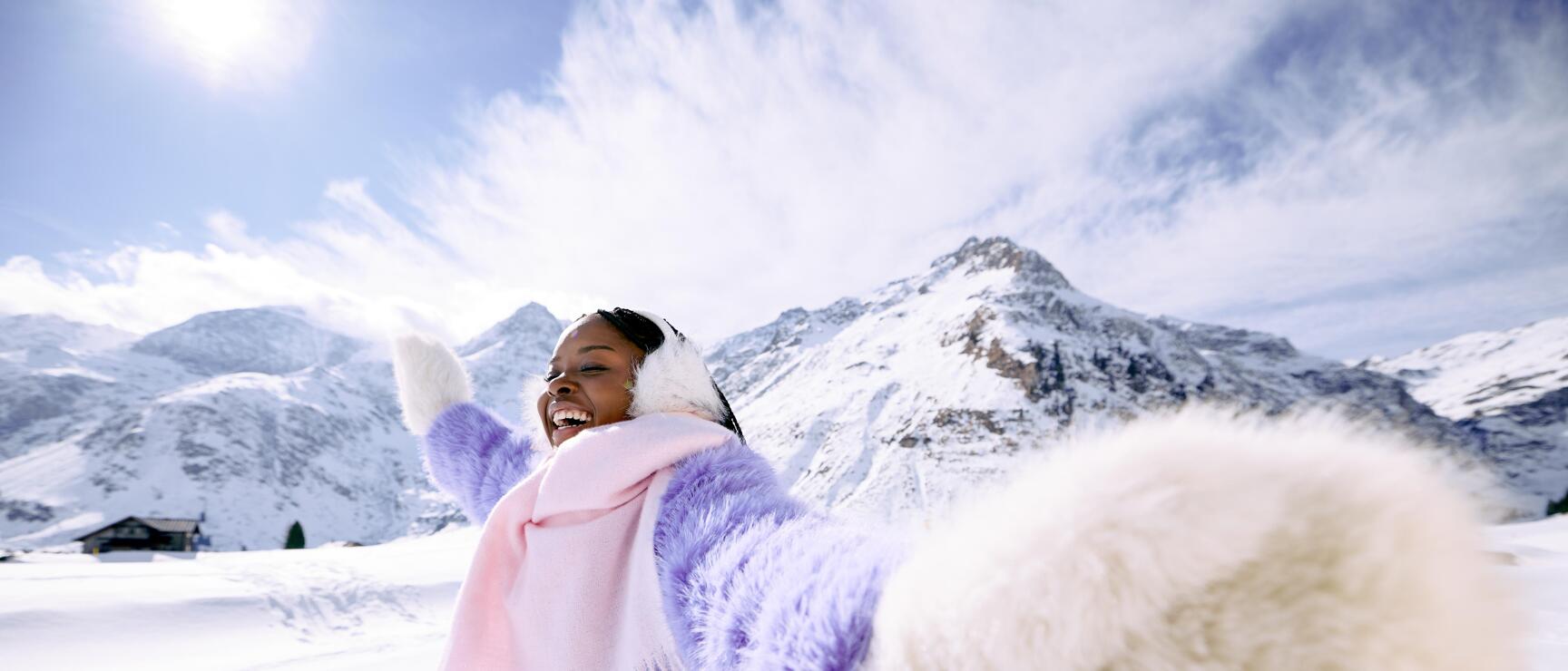
Laughing woman in purple fur jacket and pink scarf with arms outstretched, snowy mountains in background.
  1. Homepage
  2. Austria's Landscapes
  3. Holidays in the Mountains

Holidays in the Austrian Mountains
Hiking, family holidays, and skiing in the Austrian Alps

Trails to summits, alpine pastures and mountain lakes in summer; ski slopes and cross-country tracks in winter. Austria's Alps are in season all year round.

Visitors often feel the pull of these mountains as strongly as the people who call them home. For centuries, life in the Austrian Alps has been shaped by the alpine pastures and the farming that sustains them: each summer, farmers drive their cattle up to higher grazing grounds and work the pastures through the season. Around 65% of Austria's land area lies within the perimeter of the Alpine Convention.

A mountain holiday in Austria follows the seasons. In summer, trails lead to summits, alpine huts and mountain lakes – for walking, climbing and a stop at a hut along the way. In winter, life moves to the ski slopes, cross-country trails and snow-covered paths: downhill skiing, winter walking, snowshoeing, tobogganing and cross-country skiing. Get to know the Alpine way of life in Austria's mountains – they are far more than a backdrop. They are where movement, alpine farming and living traditions meet.

Source: Austrian Federal Ministry of Agriculture and Forestry, Climate and Environmental Protection, Regions and Water Management

Our favourite mountain activities in summer

Summer walks up to rustic mountain huts, climbing routes on the rock face and cycle trails with far-reaching views – there's plenty to keep you moving. In between: mountain lakes, nature parks and huts that show a different side of Austria's Alps.

Cool things to do in the mountains in winter

Winter in Austria's mountains makes room for both action and quiet: skiing on groomed pistes, tobogganing with the family, snowshoeing and winter walking through snow-covered landscapes, cross-country skiing on prepared tracks, or fat biking across the snow.

Walking, moving, climbing a mountain and coming back down again – that is a parallel to life. Seen in this way, the mountain has great symbolic power and meaning

Peter HabelerAustrian extreme mountaineer (translated from German)

Summit hikes and hiking tours

From demanding summit hikes to family-friendly trails and trail runs on the high pastures: there's more than one way up Austria's mountains. Sometimes it's a climb to the summit for sunrise, sometimes a route over alpine pastures and high-level paths to the next hut.
Reaching heights of over 3,000 metres

The 10 highest peaks in Austria

  1. Grossglockner: 3,798 m / Glockner Group in Tirol and Carinthia

  2. Wildspitze: 3,768 m / Ötztal Alps in Tirol

  3. Weißkugel: 3,738 m / Ötztal Alps in Tirol

  4. Hofmannspitze: 3,722 m / Glockner Group in Tirol and Carinthia

  5. Großvenediger: 3,666 m / Venediger Group in Tirol and Salzburg

  6. Hinterer Brochkogel: 3,628 m / Ötztal Alps in Tirol

  7. Hintere Schwärze: 3,624 m / Ötztal Alps in Tirol

  8. Similaun: 3,599 m / Ötztal Alps in Tirol

  9. Großes Wiesbachhorn: 3,564 m / Glockner Group in Salzburg

  10. Vorderer Brochkogel: 3,562 m / Ötztal Alps in Tirol

Viewing platforms and high alpine roads

Mountains and lakes from above, hairpin after hairpin through the Alps: viewing platforms, the Grossglockner High Alpine Road and the Silvretta High Alpine Road show Austria from up high.

The most beautiful Alpine regions in Austria

High peaks, alpine pastures, mountain lakes and villages shape Austria's Alpine regions. From walking and mountain biking in summer to skiing in winter, each region has a character of its own.

Accommodation in Austria's mountains

Spa hotels, mountain huts and alpine pastures each combine tradition and comfort. For a touch of luxury, spa hotels offer treatments, fine dining and panoramic views. The pastures shape the cultural landscape and are popular walking destinations.

FAQs

The summer months from June to September are particularly good for walking, mountain biking and mountain tours. At higher altitudes, patches of snow can remain even in summer. From December to March, the focus shifts to skiing, snowboarding and other winter sports.

Good options for a family holiday in Austria's mountains include Katschberg Lieser-Maltatal on the border between SalzburgerLand and Carinthia, the Hochkönig region in SalzburgerLand, and Schladming-Dachstein in Styria. In Tirol, Serfaus-Fiss-Ladis, the Wilder Kaiser and the Alpbachtal are among the family-friendly mountain regions, and in Vorarlberg the Brandnertal.

Austria's highest and most heavily glaciated mountain groups lie mainly in the west and in the Central Alps – the Ötztal Alps, the Silvretta and the Hohe Tauern, for example. Towards the east, the ranges are lower on average and the landscape more varied. Geographically, the Austrian Alps belong to the Eastern Alps.

Spectacular viewpoints include the Kaiser-Franz-Josefs-Höhe on the Grossglockner, the Dachstein Sky Walk in Styria and the 5fingers on the Krippenstein in the Salzkammergut. From the Kitzsteinhorn near Zell am See-Kaprun and the Nordkette above Innsbruck, the view stretches far across Austria's mountains.

Before setting out on a walk or mountain tour, check the weather, path conditions, difficulty and walking times. Sturdy footwear, warm clothing, rain and sun protection and enough water are all essential. Allow plenty of time, and follow local advice and signage.

You might also like

Discover the Best of Austria

Sign up for our newsletter and enjoy exclusive access to:

  • Insider tips and itineraries for your next trip to Austria

  • Traditional recipes

  • Must-see events and cultural highlights

  • Interesting stories about Austria